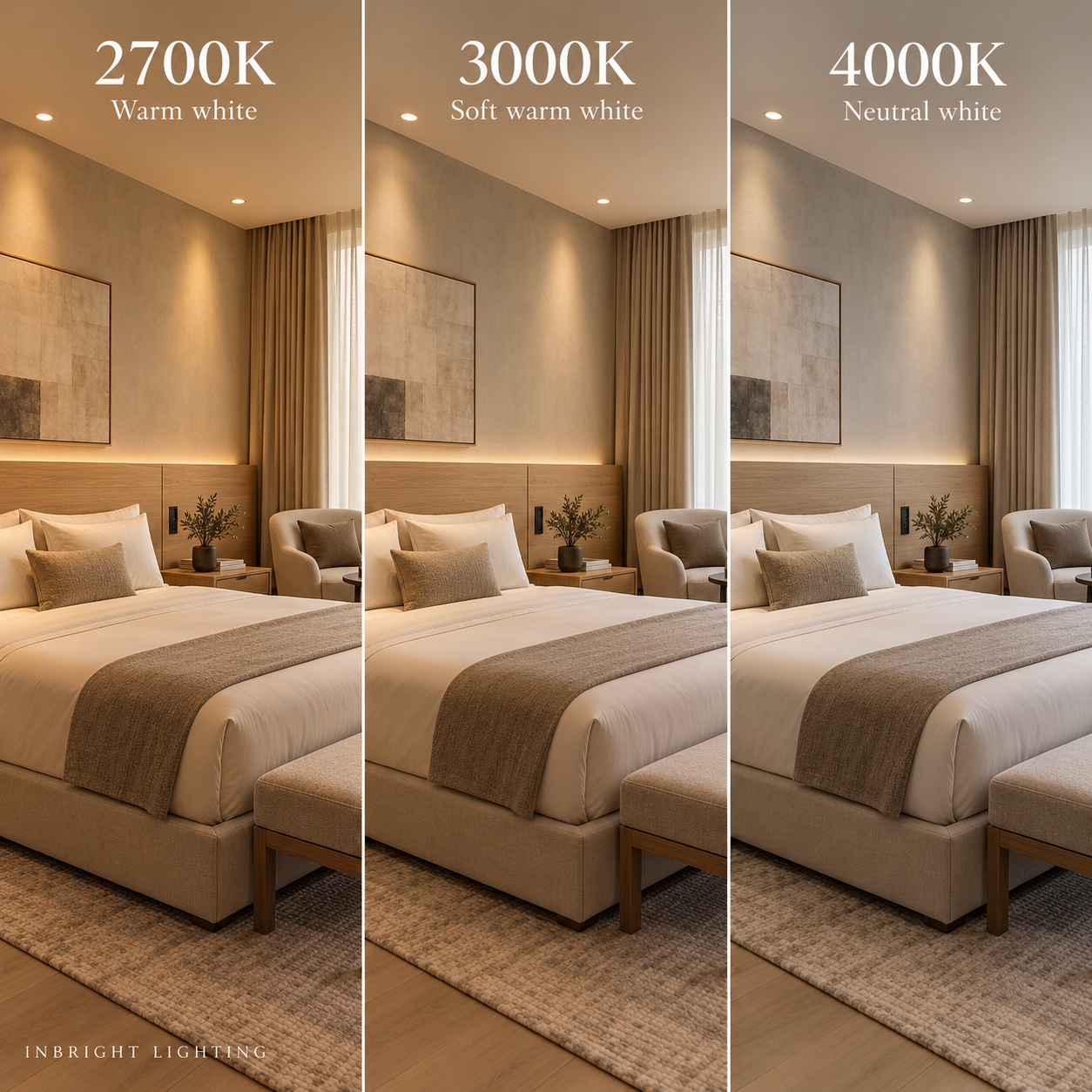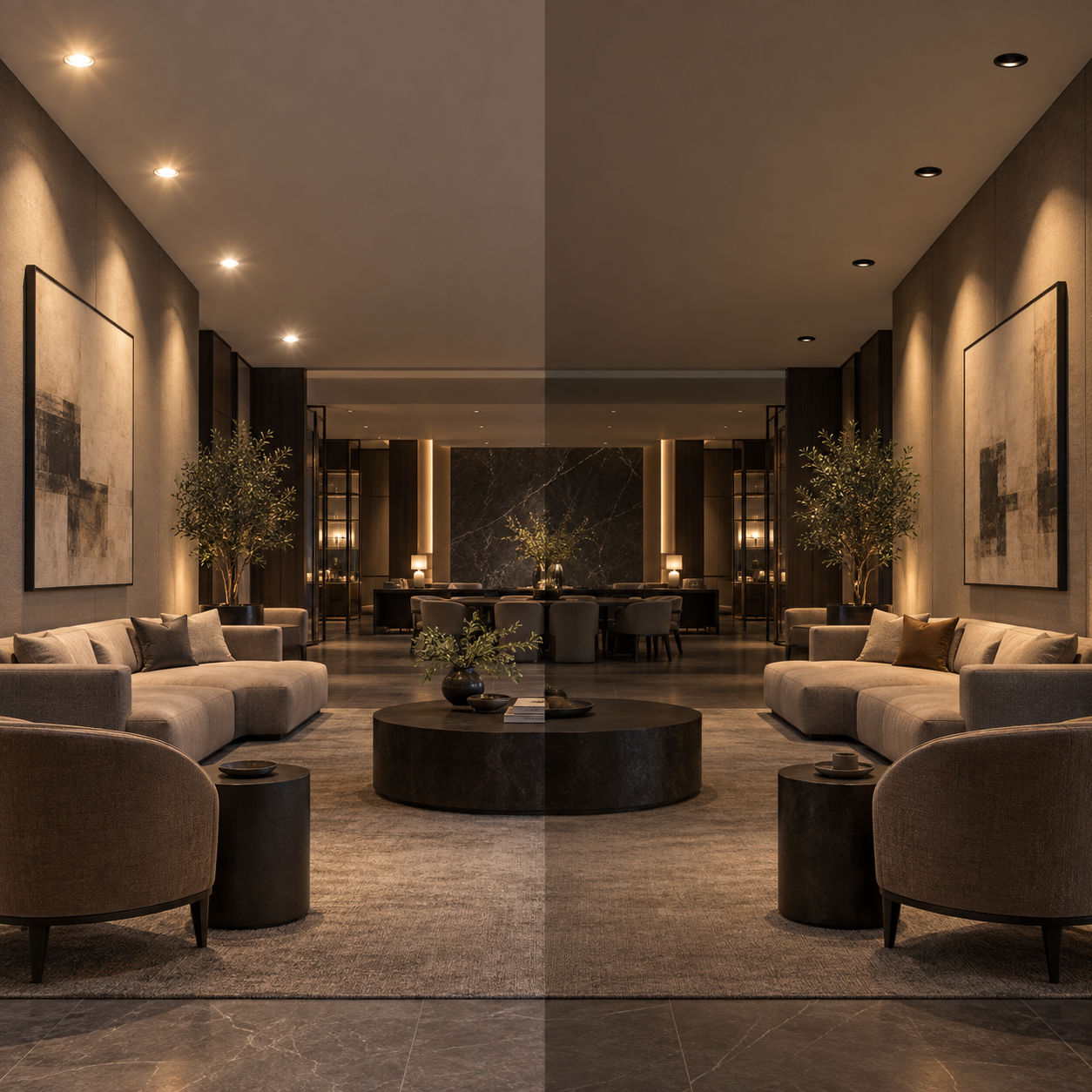
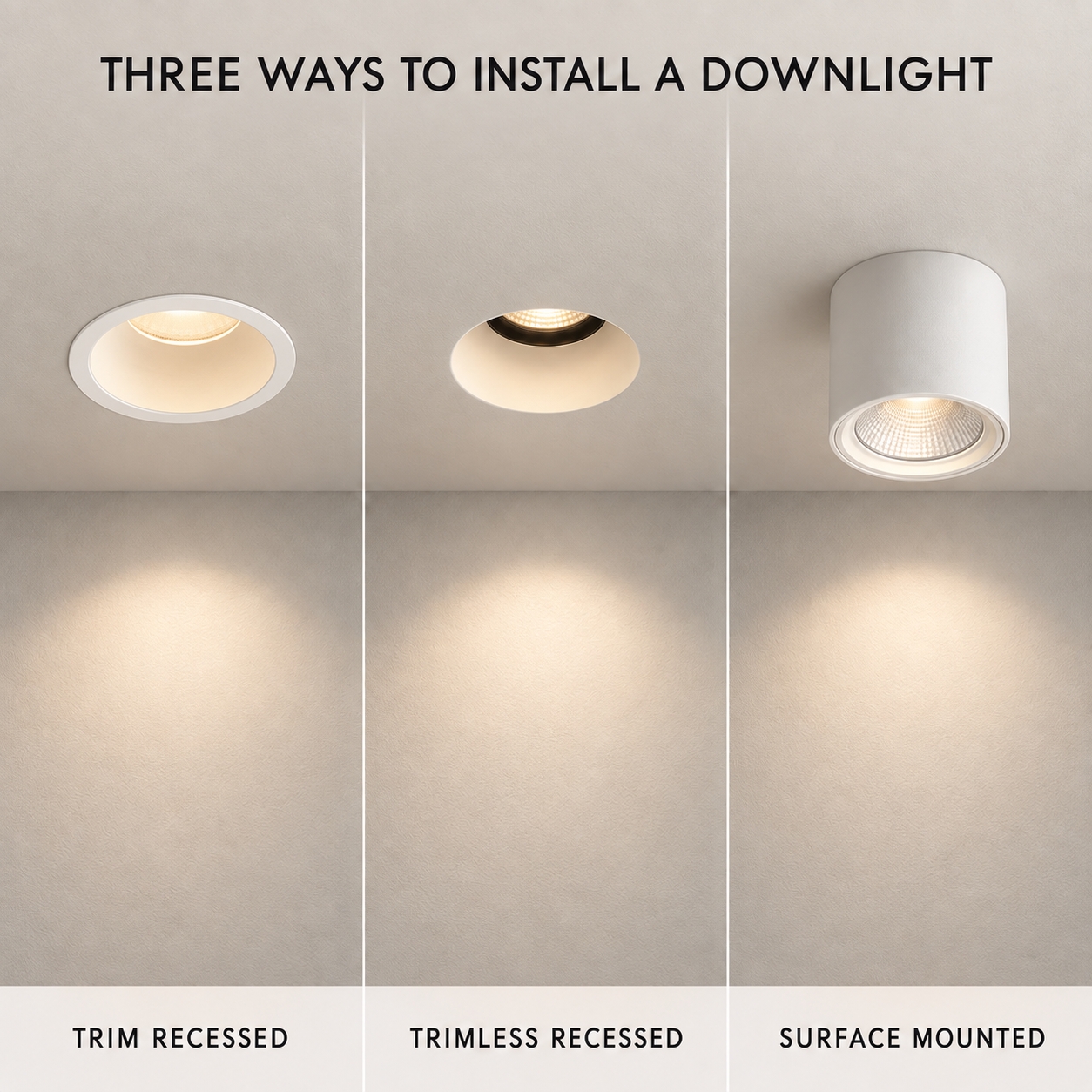



Downlights can look very different even when they produce a similar lighting effect. A visible trim creates a defined edge around the ceiling opening. A trimless downlight blends into a finished ceiling. A surface-mounted downlight sits below the ceiling instead of being recessed into it.
The right choice depends on the ceiling construction, the desired appearance and the work involved in installation. This guide compares all three options to help you select a suitable downlight for your project.
A trim downlight is recessed into the ceiling, with a visible rim covering the edge of the cutout. The trim gives the opening a neat finish and can become part of the room’s visual design.
Trim downlights are a practical option for hotel rooms, homes, offices and corridors. They are often useful in renovation projects where the ceiling is already finished, provided there is enough space above it for the fixture and its required clearances.
Trims vary in size, shape, colour and depth. A slim white trim can sit quietly against a pale ceiling, while a darker trim creates a more deliberate detail.
A trimless downlight has no visible rim around the finished ceiling opening. Its mounting frame is incorporated into the ceiling during installation, leaving a clean transition between the ceiling surface and the light aperture.
This appearance suits interiors where the ceiling should remain visually quiet, such as hotel suites, galleries and high-end residential spaces. The result depends heavily on accurate positioning and careful ceiling finishing.
Trimless installation should be planned early. The specified mounting frame must suit the ceiling system, and the installation sequence needs to allow for finishing work around the aperture. Future removal or replacement should also be considered before the ceiling is completed.
A surface-mounted downlight attaches to the face of the ceiling, leaving its housing visible below it. It can be a useful choice where there is insufficient ceiling void for a recessed fixture or where cutting a large opening is impractical.
The visible housing gives the fixture a stronger architectural presence. Depending on its shape and finish, it may either blend with the ceiling or become an intentional design element. Surface mounting still requires a suitable fixing surface, electrical connection and any clearances specified for the chosen model.
| Feature | Trim downlight | Trimless downlight | Surface-mounted downlight |
|---|---|---|---|
| Position | Recessed into the ceiling | Recessed and finished into the ceiling | Mounted below the ceiling |
| Visible detail | Rim around the opening | No visible rim | Visible housing |
| Ceiling work | Cutout and sufficient recess space | Coordinated cutout, frame and finishing work | Suitable fixing point and cable connection |
| Best planning stage | New build or renovation | Ideally before ceiling finishing | New build or renovation |
| Typical visual effect | Neat, defined ceiling opening | Minimal ceiling appearance | Deliberate architectural form |
These are installation and appearance differences. None of the three types automatically provides better light quality or glare control.
It can affect what people see at the ceiling, but glare depends mainly on the complete optical design and installation. Consider the position of the light source, reflector or lens, beam angle, light output, fixture placement and normal viewing directions.
For example, a trimless downlight may create a very clean ceiling appearance while still exposing a bright light source. A well-designed surface-mounted fixture may provide comfortable light despite its visible housing. Assess the actual photometric performance rather than judging by mounting style alone.
Choose a trim downlight when you want a recessed appearance with a clearly finished edge, particularly in a ceiling that has already been completed.
Choose a trimless downlight when a seamless ceiling is a design priority and the project can accommodate coordinated installation and finishing work.
Choose a surface-mounted downlight when recess space is limited or a visible fixture suits the architectural concept.
Before finalising the specification, check the ceiling construction, available mounting depth, fixture dimensions, required clearances, maintenance access and electrical requirements. Then select the beam angle and light output according to the surface or activity you need to illuminate.
Trim, trimless and surface-mounted downlights solve different ceiling design and installation needs. A trim downlight offers a defined recessed finish. A trimless downlight creates a more seamless ceiling. A surface-mounted downlight provides an option when recessing is difficult and can add a visible architectural detail.
Start with the ceiling conditions and visual goal, then verify the lighting performance of the exact fixture. That approach will produce a result that works both as part of the architecture and as a source of useful, comfortable light.
Building 2, No.442, Wuyi Road, Jianghai District, Jiangmen City, Guangdong, China.
admin@inbright-lighting.com
0086 - 13424998756
Copyright © Jiangmen Inbright Lighting Co., Ltd All Rights Reserved. 粤ICP备2025393167号 Sitemap XML