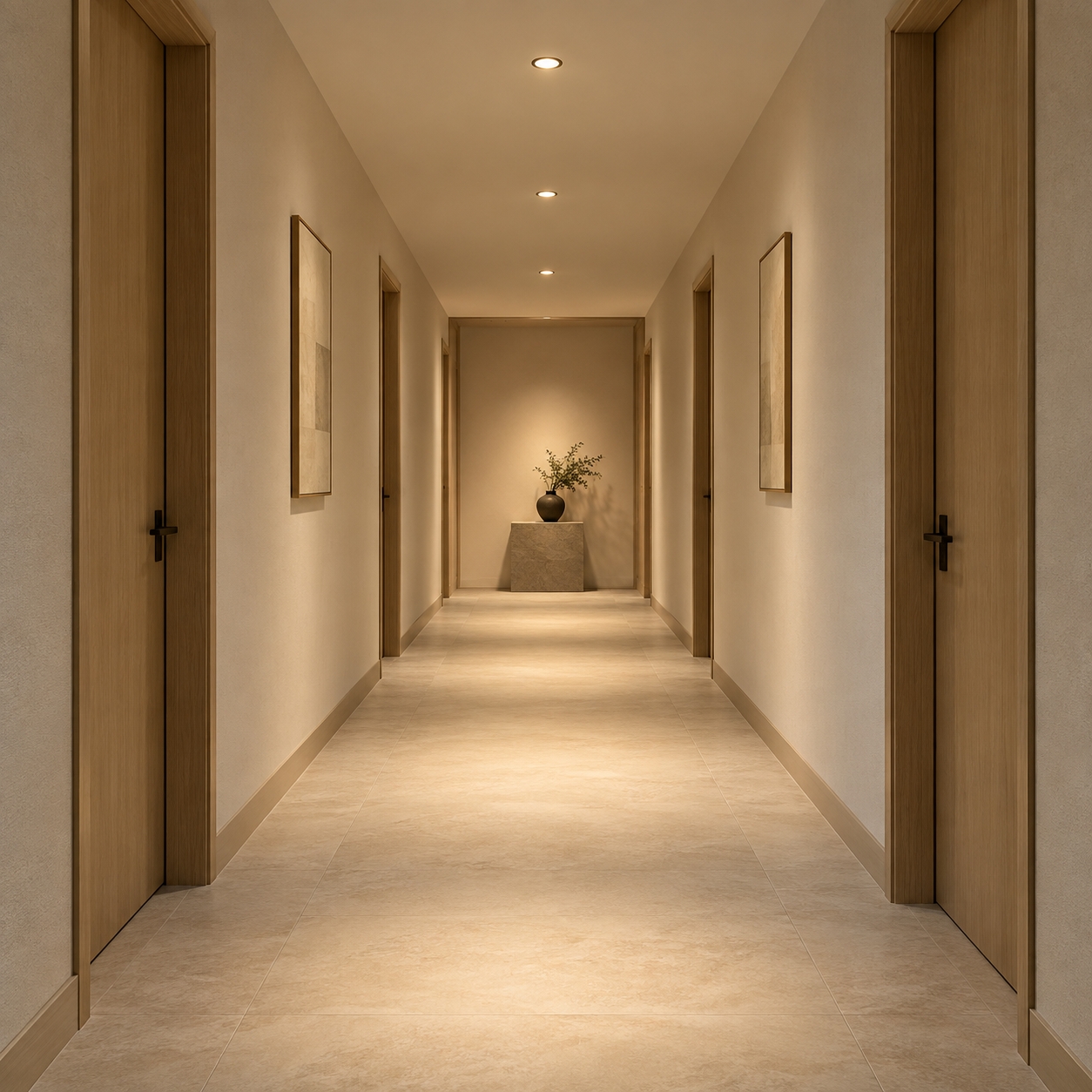
Two downlights can have the same wattage and colour temperature yet create very different spaces. One may produce a focused pool of light on a table or artwork. The other may spread light across a walkway or seating area. The difference is largely determined by beam angle.
Narrow and wide beams serve different purposes. Understanding how each distributes light will help you choose downlights for general lighting, accent lighting and the spaces that need both.
Beam angle describes the main spread of light from a luminaire. Technically, it is measured between the directions where luminous intensity falls to 50% of its maximum value. Light can still be visible beyond that angle, so the stated beam angle is not a sharp boundary around the illuminated area.
Beam descriptions are relative rather than universal. For practical downlight planning, 15° and 24° are often treated as narrow options, 36° as a medium option, and 60° as a wide option. The exact light pattern still depends on the fixture’s optical design.
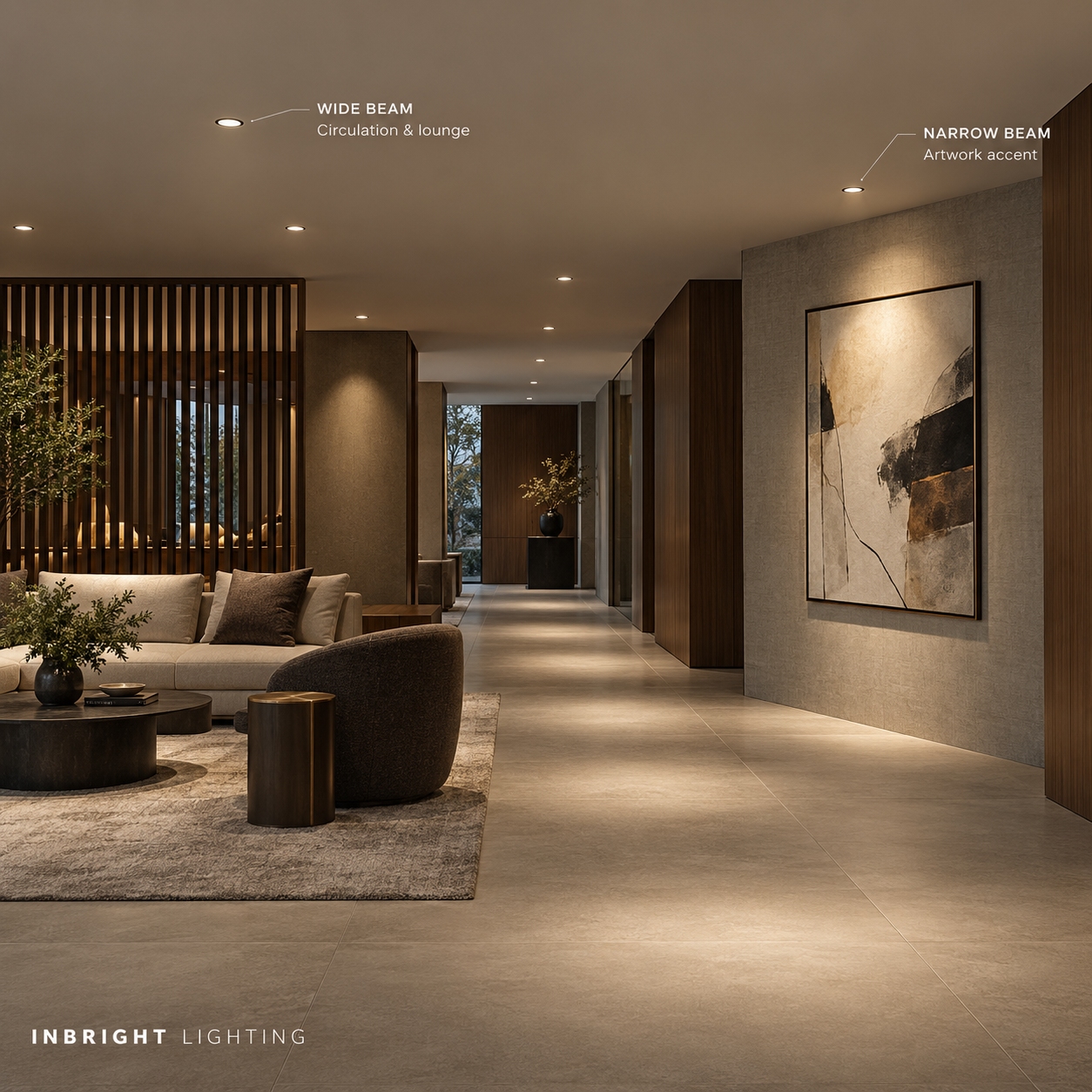
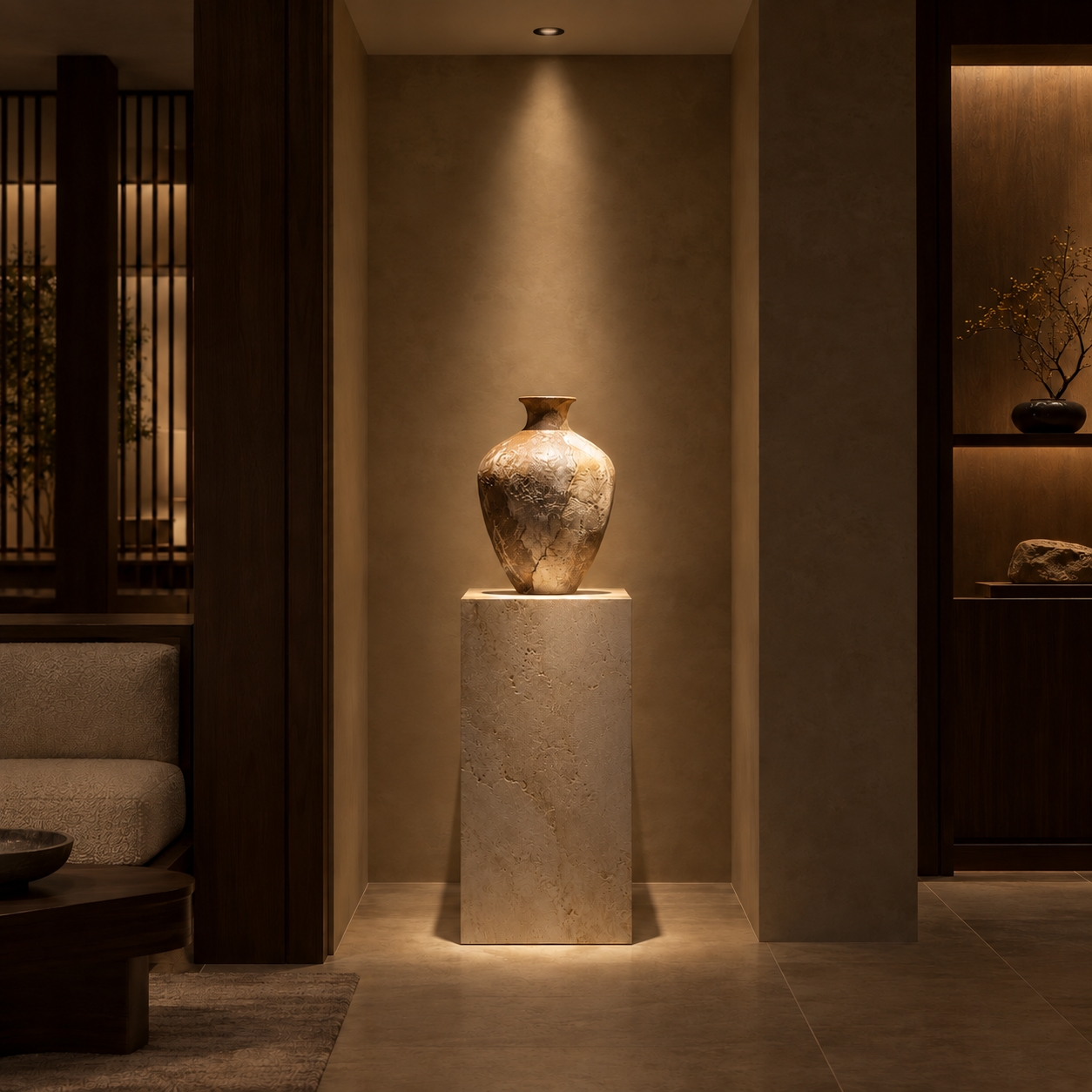
A narrow beam concentrates light on a smaller target area. It creates contrast between the illuminated subject and its surroundings, helping guide attention.
Narrow-beam downlights are useful for:
Accurate positioning matters. If the beam misses a small target, the result becomes obvious. For a wall display or artwork, an adjustable downlight may provide the aiming control needed after installation.
A narrow beam does not automatically mean better glare control. A bright aperture can still be uncomfortable when it falls within someone’s normal line of sight.
A wide beam spreads light over a larger area. It is commonly used where the goal is comfortable, relatively even general lighting rather than a strong highlight.
Wide-beam downlights can suit:
A wide beam covers more area, but coverage alone does not guarantee sufficient brightness. With the same luminous flux, spreading light across a larger surface generally reduces intensity near the centre compared with a narrower distribution. Fixture output, spacing and mounting height must be checked together.
| Consideration | Narrow beam | Wide beam |
|---|---|---|
| Primary purpose | Focused accent lighting | Broader general lighting |
| Area covered | Smaller | Larger |
| Visual effect | Stronger emphasis and contrast | Softer transitions across a space |
| Placement | Precise positioning is important | Spacing and overlap are important |
| Common application | Artwork or displays | Walkways or room lighting |
Neither is universally better. The choice depends on the size and position of the target and the atmosphere you want to create.
The farther a beam travels, the larger its nominal footprint becomes. An approximate diameter on a flat surface can be calculated as:
Beam diameter ≈ 2 × distance to target × tan(beam angle ÷ 2)
At a distance of 2.5 metres, a 24° beam has a nominal diameter of about 1.06 metres, while a 60° beam has a nominal diameter of about 2.89 metres. These figures illustrate the geometric difference; they do not predict the actual brightness or the full visible extent of light.
Measure the distance to the target surface, not simply the floor. A dining table, worktop or wall feature may be much closer to the luminaire than the floor is. For important projects, use the exact fixture’s photometric data to check the illuminated area.
Yes. Combining beams often creates a clearer lighting hierarchy than using one distribution everywhere.
In a hotel guest room, wide beams can support circulation and general visibility, while narrow beams highlight a feature wall or seating area. In retail, wide beams can light the main floor and narrow beams can draw attention to merchandise. Keep the colour appearance and fixture placement coordinated so the lighting feels intentional.
Avoid placing narrow beams in a uniform ceiling grid without identifying what each one should illuminate. Likewise, avoid relying on a wide beam to create a precise highlight on a small object.
Then review the fixture’s lumen output, intensity distribution and IES or LDT file. Two downlights labelled with the same beam angle may still produce noticeably different results.
Choose a narrow beam when you want to direct attention to a defined subject. Choose a wide beam when you need broader, more even coverage. Use both when a room needs general light and selected accents.
Beam angle is one part of the decision. The final result depends on the downlight’s optics, output, mounting height, spacing and aiming direction. Plan those factors together to place light where it is useful and make the space comfortable to experience.
Building 2, No.442, Wuyi Road, Jianghai District, Jiangmen City, Guangdong, China.
admin@inbright-lighting.com
0086 - 13424998756
Copyright © Jiangmen Inbright Lighting Co., Ltd All Rights Reserved. 粤ICP备2025393167号 Sitemap XML